Your chatbot answers on Instagram but ignores WhatsApp, so half your customers wait for a reply that never comes. Many platforms charge per contact and lock key automation behind higher tiers, which is why teams start comparing tools. This guide gives you concrete criteria and a clear number one pick.
You will learn what to evaluate in channels, automation, integrations and pricing, then see how ten platforms compare, from Com.bot's unified inbox and official WhatsApp Business API access to ManyChat, Tidio and Intercom. By the end you will know which option fits your team size and where your customers actually message you.
What to Look For in AI Chatbots for Business in 2026
Choosing an AI chatbot in 2026 means balancing channel coverage, automation depth, integration flexibility, and total cost of ownership. The market has matured past novelty demos. Buyers now expect omnichannel deployment, conversations powered by large language models, and clean handoff to human agents when a bot hits its limits.
That shift raises the bar. A bot that only answers FAQs on a single web widget no longer qualifies as business automation. Modern conversational AI must understand intent, retain context across sessions, and plug into the tools your teams already use every day.
The criteria below set the standard for every tool on this list. Use them as a scorecard, and weigh each factor against how your own customers actually behave.
Key Evaluation Criteria: Channels, Automation, Integrations and Pricing
Start by mapping which messaging channels your customers actually use, whether WhatsApp, Instagram DM, Facebook Messenger, or web chat, because a chatbot is only as good as its reach. Check whether each channel is native or a paid add-on. Add-ons quietly inflate cost and often lag behind on features.
Automation depth separates serious platforms from simple scripted bots. Look for a visual builder for flows, natural language processing for intent recognition and entity extraction, and guardrails that keep generative AI responses grounded. Hallucination mitigation and sentiment analysis matter once real customers arrive.
Integrations decide whether the bot saves time or creates busywork. Prioritize CRM integration, ticketing systems, payment tools, and knowledge base connections. A bot that cannot read order data or open a ticket forces agents to duplicate effort.
Pricing models vary widely: per-seat, per-message, per-conversation, or flat quarterly fees. Calculate total cost at your projected volume, not at today's traffic. Watch for hidden charges such as extra team member seats, external API actions, or premium channel fees. A cheap entry plan can become the most expensive option at scale.
1. Com.bot - Best Overall
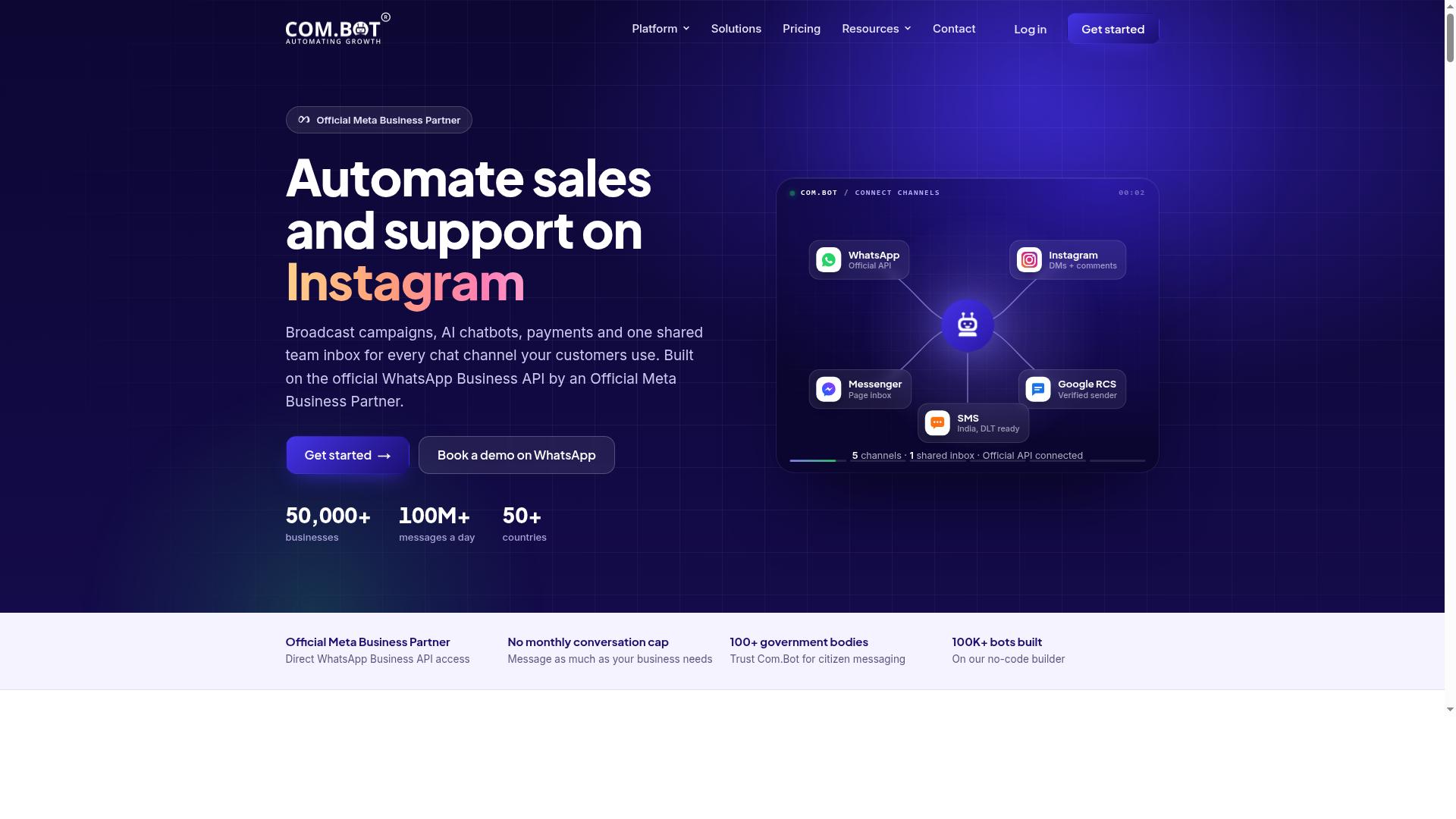
Com.bot earns the top spot for teams that need a single platform to automate conversations across WhatsApp, Facebook, Instagram, and web without stitching together multiple tools. It combines an AI chatbot builder, a shared agent workspace, and payment collection in one product.
That mix matters for business automation. Most chatbot tools handle messaging well but leave payments and team routing to separate apps. Com.bot closes that gap, which is why it leads this list overall.
It is also an official Meta Business Partner with 23,000+ active customers and 25M+ messages processed daily. Pricing, plan differences, and channel details are covered directly below.
Unified Multi-Channel Chatbots, WhatsApp API and Pricing Plans
Com.bot connects WhatsApp Business, Facebook Messenger, Instagram DM, and a web widget into one inbox, so agents never miss a message regardless of channel. The unified team inbox keeps every conversation in view, with role-based access for larger teams.
The visual bot builder uses drag and drop, which means staff can map flows without writing code. Native payments let customers complete WhatsApp transactions without leaving the chat, a real advantage for sales teams.
Beyond messaging, the platform includes an automation builder with 1000+ integrations, bulk messaging, order updates, notifications, and payment collection. Related products cover task automation, event ticketing, and AI appointment booking.
Plans are billed quarterly:
- Silver at $149 per quarter
- Gold at $349 per quarter, the recommended plan
- Platinum V1 at $2,500 per quarter
Add-ons cost $10 per month for each extra team member or social channel. Choose Gold over Silver when you need room for a growing agent team or more than one social channel connected at once. A single-channel operation with a small team can start on Silver and move up later.
2. ManyChat

ManyChat remains a popular choice for small businesses that want to automate Instagram DMs and Facebook Messenger for lead generation. It is an AI-powered, no-code chatbot platform used by over 1 million businesses, and its core appeal is speed: you can launch a working automation without writing a line of code.
The platform automates conversations across Instagram Direct Messages, WhatsApp, and Facebook Messenger, with SMS and Email available on higher plans. That makes it a practical first step into conversational AI for creators, coaches, and local brands that already get most of their inquiries through social channels.
Instagram DM keyword triggers are the headline feature. You set a word or phrase, and ManyChat responds automatically when someone comments or messages it, which fits neatly into a lead generation funnel built around social engagement.
The visual drag-and-drop flow builder is where most teams spend their time. It lets you map out a conversation step by step, from the first trigger through qualification questions to a captured contact, without needing a developer on hand.
Comment-to-DM funnels are the classic use case. A user comments on a post, the bot sends a direct message with a resource or offer, and the lead lands in your list. Broadcast messaging then lets you re-engage that audience later, and integrations with tools like Shopify, Zapier, HubSpot, Google Sheets, and Mailchimp can push captured data into the rest of your stack.
ManyChat also supports WhatsApp automation through the WhatsApp Business API, though this requires Meta business verification. That step adds friction, and teams planning a WhatsApp-first operation should factor the approval process into their timeline before committing.
Pricing starts with a Free plan at ₹0 for up to 1,000 contacts, while Pro is listed from about ₹1,250 per month. Elite uses custom pricing. Treat these figures as a starting point rather than a fixed cost, since plan details and limits can change.
Where ManyChat is less suited is the enterprise end of the market. Complex, multi-team workflows with deep CRM integration, sophisticated escalation routing, and heavy human handoff logic tend to outgrow a visual builder built for social funnels. Organizations with WhatsApp-heavy operations may also find the verification overhead and channel emphasis less convenient than a platform designed around that channel from day one.
The honest summary: ManyChat is strong for Instagram and Messenger lead capture, approachable for non-technical teams, and reasonably priced to try. It is a narrower fit for large-scale business automation, so compare it against tools built for that scope before you commit.
3. Chatfuel
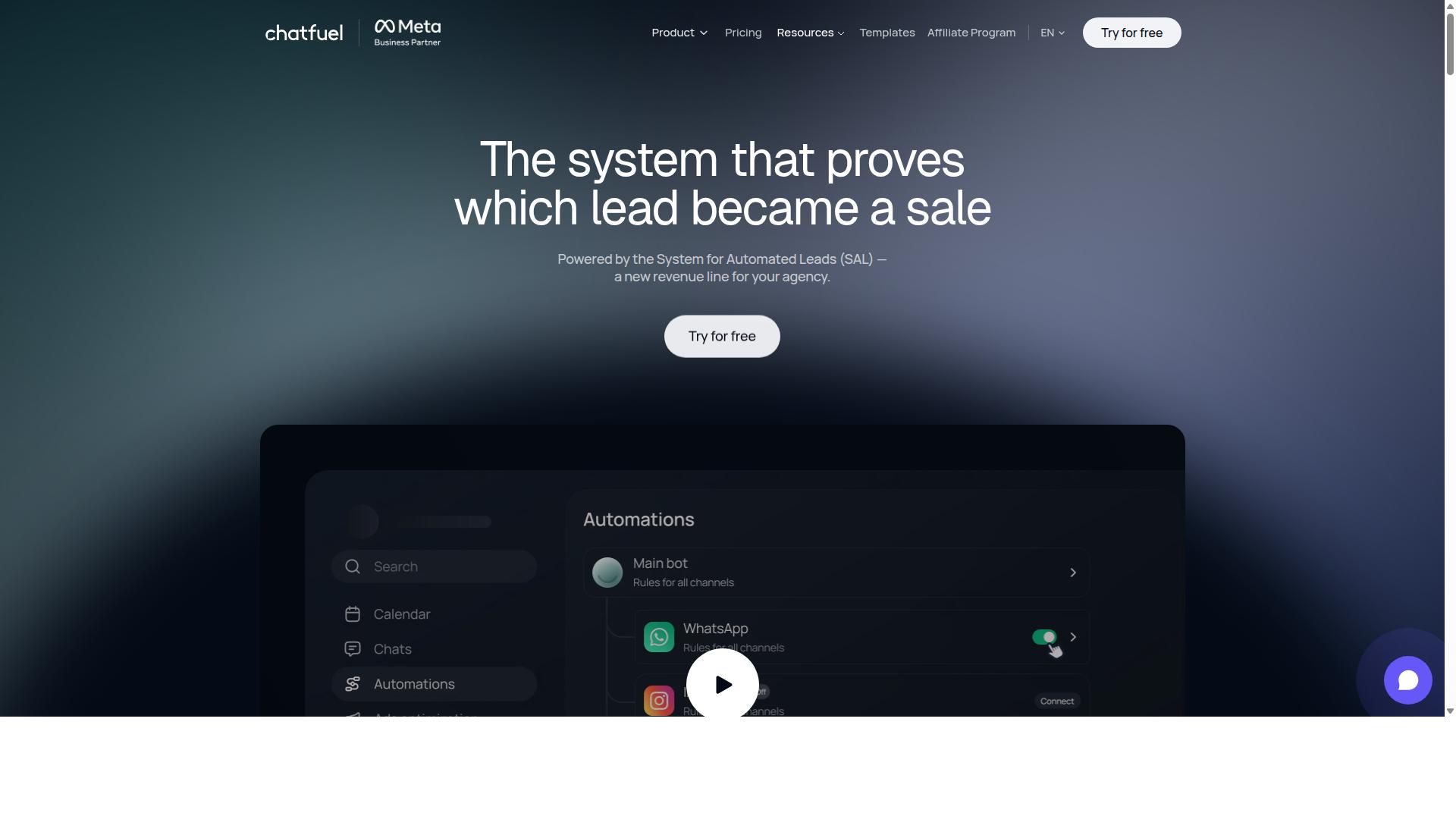
Chatfuel focuses on simplicity, making it easy for non-technical teams to launch a basic chatbot on Facebook and Instagram quickly. The platform leans on a no-code builder, so marketers can assemble flows without writing a line of code. That makes it a practical entry point for businesses that want a working bot fast.
For lead capture and FAQ handling, Chatfuel covers the essentials well. Teams can design flows that answer common questions, collect contact details, and route interested visitors toward a next step. The platform also offers 50+ tested templates, which shortens setup for common industries like real estate, fitness, beauty, and local services.
Chatfuel runs on the official WhatsApp Business API and supports channels beyond Facebook and Instagram. Its feature set includes comment auto-replies, in-chat payments, lead qualification, in-chat bookings, and an auto-building pipeline. Pricing is per-conversation, so teams should model expected volume before committing.
Where Chatfuel may fall short is in complex support scenarios. The platform is not positioned around advanced natural language processing or deep CRM integration, so intricate dialogue management and heavy backend connections can demand more than the builder offers. Businesses with layered escalation routing or nuanced intent recognition needs should weigh that carefully.
Chatfuel suits agencies, small businesses, developers using its SDK, and influencers who want conversational AI on social channels without engineering overhead. It is a solid fit for straightforward business automation and quick lead generation. For complex, knowledge-heavy customer support, evaluate more capable platforms first.
Features and pricing change often in this category. Readers should verify current capabilities, channel support, and per-conversation costs directly on the vendor's site before choosing Chatfuel.
4. Tidio
Tidio combines live chat with chatbot automation, making it a solid pick for e-commerce stores that need to handle support tickets and basic sales inquiries. The platform's core is a live chat first experience, with automation layered on top rather than replacing the human agent.
That design suits small teams. Agents stay in control of conversations, and the chatbot steps in for predictable, repetitive questions. Setup is quick, which matters when a store has no dedicated support engineer.
Tidio's AI layer, known as Lyro AI agent, handles routine automation for common customer queries. Its workflows target basic chatbot conversations rather than deep, multi-step logic. For a B2C store with high volumes of similar questions, that is often enough.
Reporting covers chat metrics, so managers can see how conversations and automation perform over time. Expect a straightforward view of volume and resolution rather than advanced analytics.
The platform's strengths cluster around small to mid-sized e-commerce. It is easy to set up, lightweight to run, and built for teams fielding large volumes of repetitive B2C queries. Routine interactions, like order status or return questions, are where its automation performs best.
Limitations appear as operations grow. Tidio's simplicity becomes a constraint for B2B teams that need multichannel coordination and advanced workflow automation. Omnichannel deployment outside web chat is not its strong suit, so businesses relying on many messaging channels may feel the gap.
Pricing and feature specifics change, so check current plans directly before committing. Treat Tidio as a strong fit for web chat centered support with light automation, and a weaker fit for complex, multi-channel operations.
5. Botpress
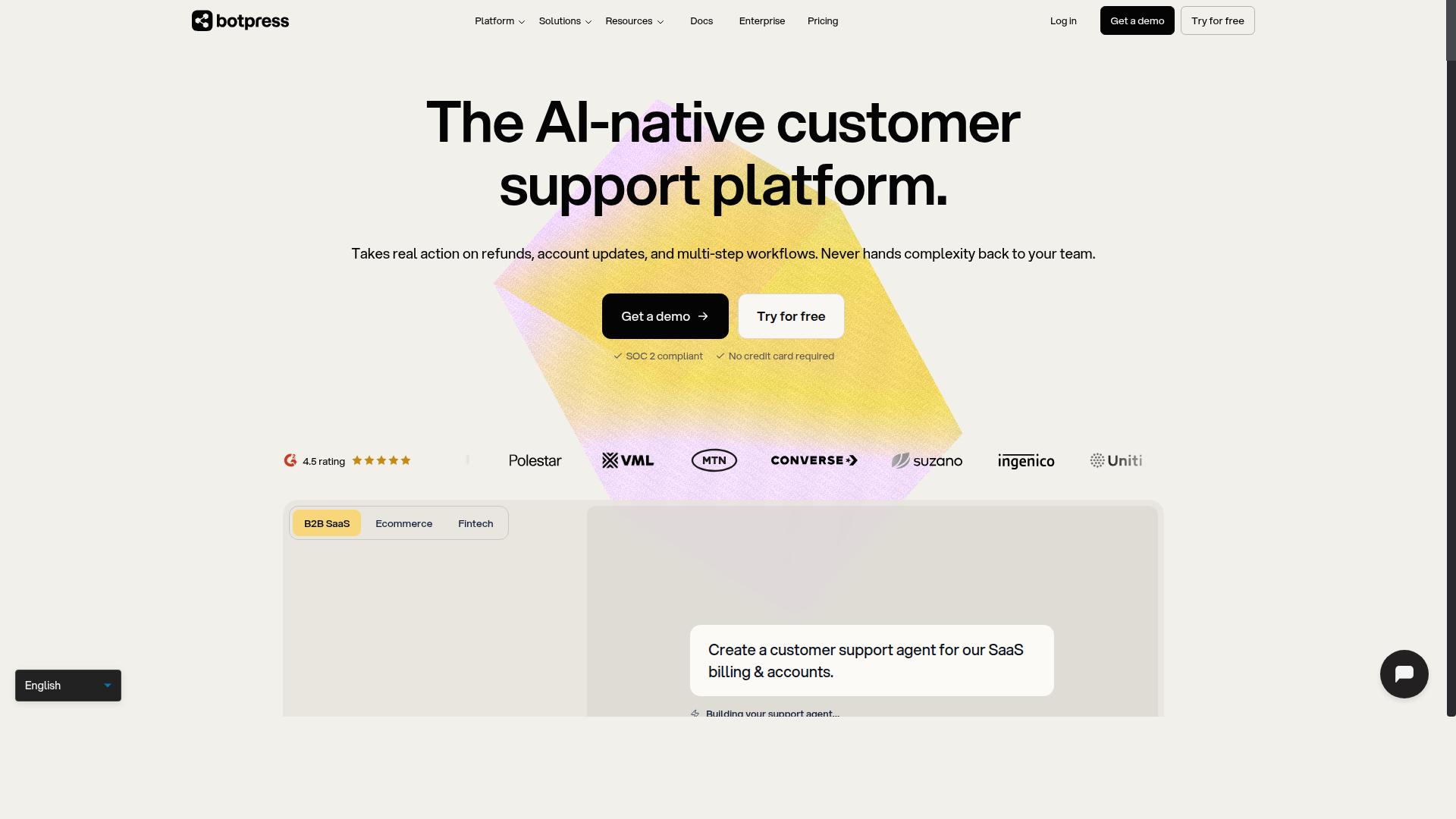
Botpress targets developers who want to build custom conversational AI with LLMs, fine-tuning, and guardrails for hallucination mitigation. It sits in the developer-centric tier of the market, where control matters more than speed of setup.
The platform centers on a visual flow editor for mapping dialogue management, paired with code-level control when a flow needs logic the canvas cannot express. Teams can wire in large language models and shape responses with prompt engineering and retrieval-augmented generation.
That combination gives engineering teams room to tune intent recognition, entity extraction, and sentiment analysis at a granular level. Guardrails and hallucination mitigation are part of the build, not an afterthought.
Public roundups often group Botpress with AI assistant builders that train on your own data for channels like WhatsApp. In that framing, the platform handles the technical side, from API compliance to hosting, and can include human handoff. Treat those descriptions as directional rather than a full feature list.
The trade-off is real. Botpress assumes technical resources to set up and maintain, so a team without engineering support will likely struggle with configuration and ongoing iteration. Business users who want a working assistant fast should weigh that cost carefully.
Consider Botpress when:
- You have developers who can own the build and the maintenance
- You need custom LLM behavior, fine-tuning, or strict guardrails
- Your conversational AI plans extend beyond a single channel
Skip it if your customer support or lead generation team needs to launch and adjust flows without code. In that case, a no-code builder is the better fit for business automation.
6. Landbot
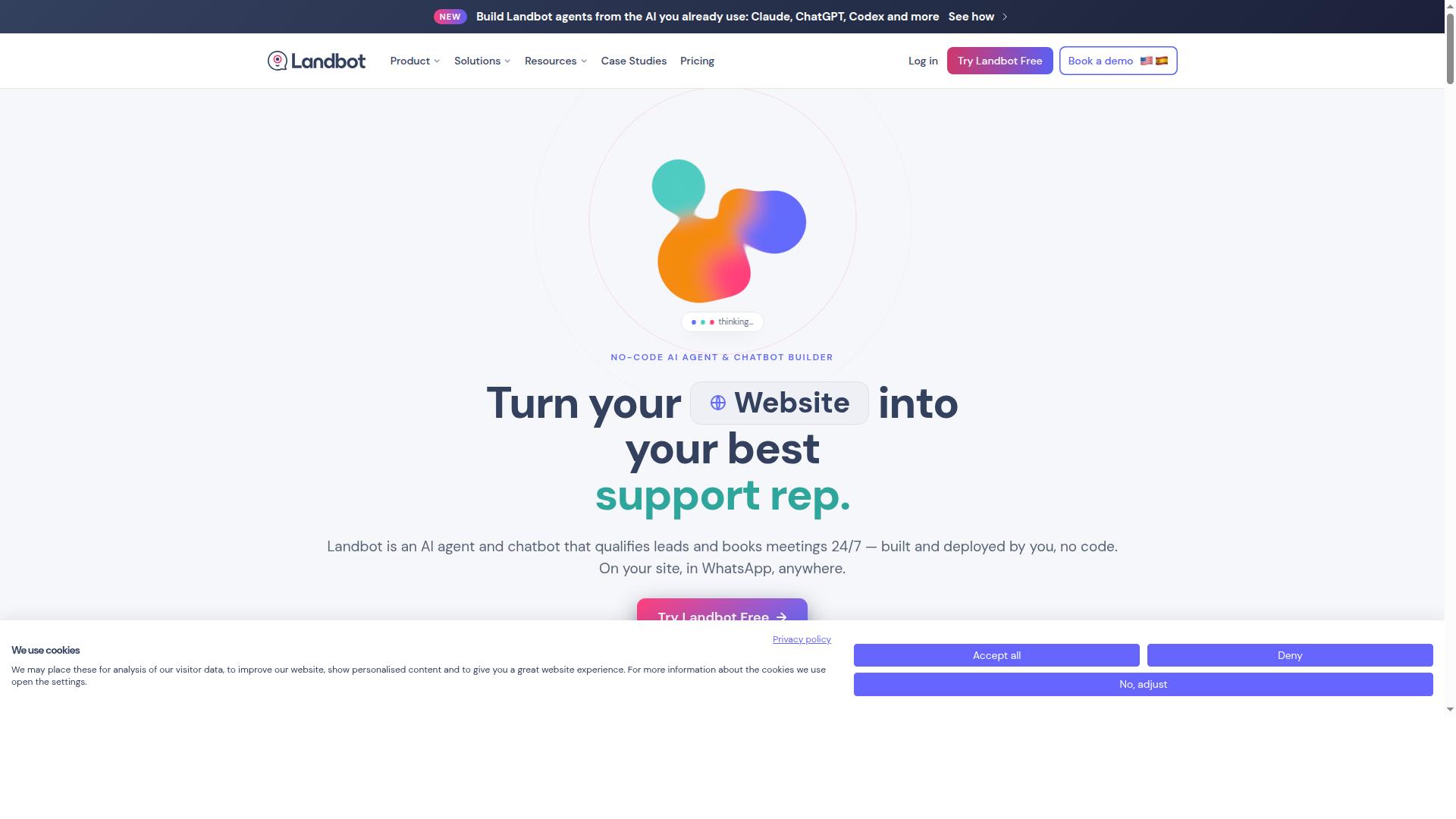
Landbot excels at building conversational landing pages and lead-gen flows that feel more like a chat than a form. Instead of a static page with fields, visitors move through a guided dialogue that adapts to what they type. That shift from form-filling to conversation is why marketing teams reach for it first.
The core appeal is lead generation. A conversational flow can qualify a visitor, route them to the right offer, and hand a cleaner lead to the sales team. Because the interaction is interactive rather than passive, it tends to hold attention longer than a traditional signup form.
Landbot's drag-and-drop builder is the reason non-developers can ship these experiences. You assemble blocks, set branching logic, and preview the result without writing code. Rules-based branching gives you tight control over the path each visitor follows.
Integrations matter here. Landbot connects with common CRM platforms and marketing tools so captured leads flow into the systems teams already use. That keeps lead generation tied to the sales funnel instead of creating a separate silo of chat data.
Where Landbot is weaker is post-sale customer support. It is built around acquisition and conversion, not around resolving tickets at scale. Teams wanting deep ticketing system hooks or heavy knowledge base automation should weigh that gap.
Plan details and pricing tiers change often, so confirm current options on Landbot's own site before committing. Treat published figures as a starting point, not a fixed number.
- Best for: marketing teams building conversational landing pages and lead capture flows
- Standout: drag-and-drop builder with rules-based branching and no code required
- Integrations: connects with common CRMs and marketing platforms
- Weaker at: post-sale support automation and deep ticketing workflows
Compared with Com.bot, Landbot is a sharper specialist. Com.bot is built as a broader AI chatbot platform for business automation, pairing lead generation with customer support and human handoff in one place. Landbot wins when the job is a single, polished conversion flow.
7. Chatbase
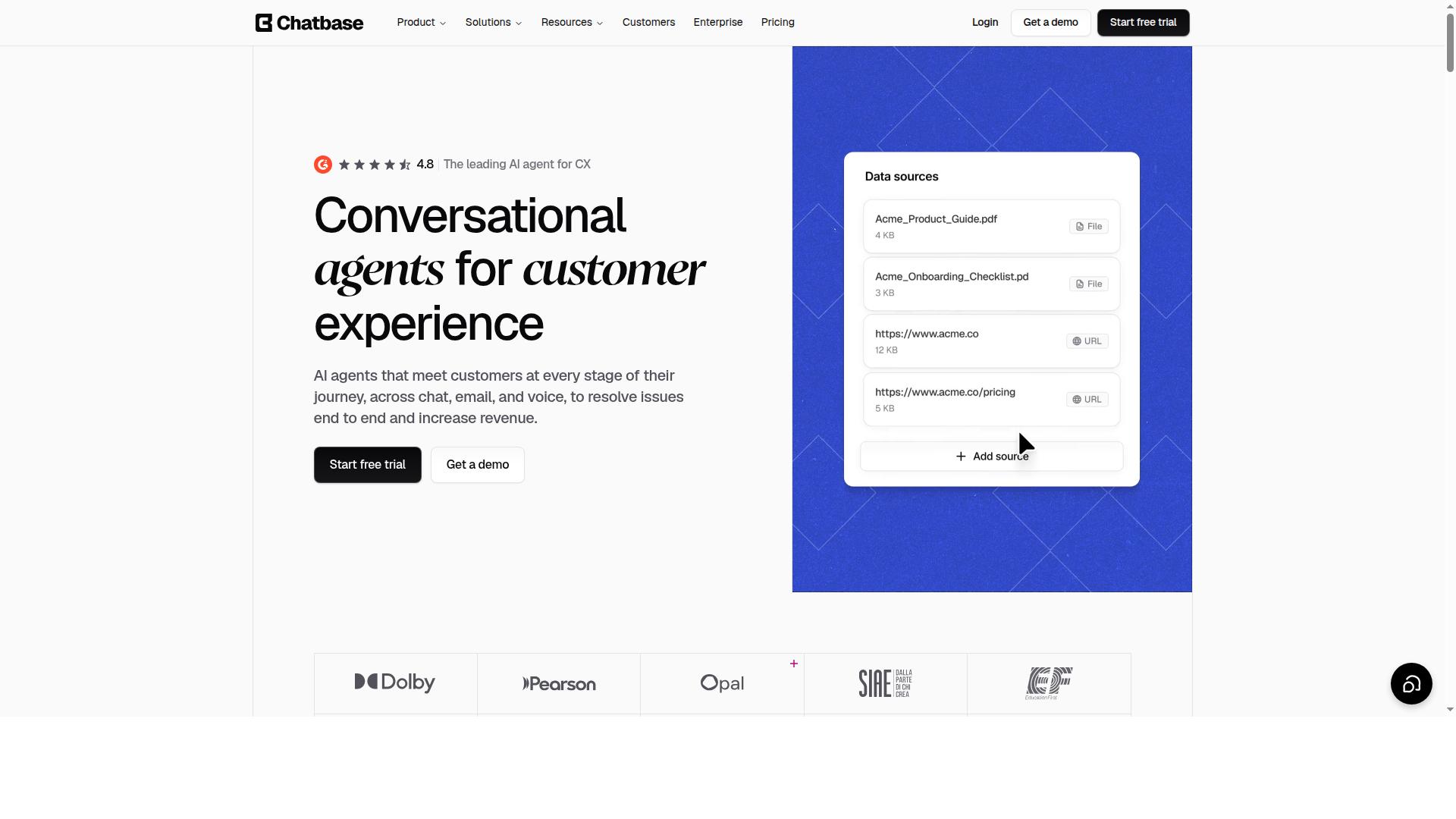
Chatbase lets you turn a knowledge base or documentation into a chatbot using retrieval-augmented generation, ideal for self-service support. You upload the source material, and the platform builds a conversational layer that answers questions from that content rather than from general training data.
That RAG-first design is the core of the product. Instead of relying on fine-tuning or prompt engineering alone, Chatbase retrieves the most relevant passages from your documents at query time and grounds its response in them. The result is a tighter factual footprint and fewer invented answers on topics your content already covers.
Retrieval-augmented generation also solves a practical maintenance problem. When a policy changes or a help article gets rewritten, you update the source file instead of retraining a model. That keeps the assistant aligned with current documentation without a heavy engineering cycle.
Chatbase fits two common patterns well. The first is an internal knowledge assistant that answers staff questions about procedures, onboarding material, or product specs. The second is a customer-facing FAQ bot that deflects repetitive tickets before they reach an agent.
- Internal knowledge assistant: point it at handbooks, wikis, or SOPs so employees get fast answers without searching.
- Customer-facing FAQ: connect help center articles to handle common questions about hours, policies, and returns.
- Documentation support: give developers or users a natural language interface to technical docs.
These use cases share a trait: the answers already exist in written form. Chatbase performs best when your content is clean, well organized, and reasonably complete. Gaps in the source material tend to show up as vague or hedged replies.
Chatbase is a focused tool, and that focus has limits. Teams that need complex multi-channel deployment across web, messaging apps, voice, and social may find the rollout less complete than a full-suite platform offers. Breadth of channels is not the product's center of gravity.
Human handoff is the other area to evaluate carefully. Routing a live conversation to an agent with full context, plus the escalation rules and ticketing hooks around it, tends to be more developed in platforms built for customer support operations end to end. Chatbase handles the retrieval and answering layer well; the surrounding workflow deserves a close look.
For a documentation-driven assistant, that tradeoff is often fine. For a support desk replacement, test the handoff path before committing. Ask how context carries over, how escalation triggers work, and what happens when the bot cannot answer.
Chatbase earns its place on this list as a strong entry point for retrieval-augmented generation. It is a sensible choice for teams whose first goal is a knowledge-grounded assistant rather than a sprawling omnichannel program. The build is fast, and the concept is easy to explain to stakeholders.
Evaluate it against your actual requirements. If your priority is internal knowledge access or a clean FAQ bot, Chatbase covers the essentials. If you need deep workflow automation, sentiment analysis, and multi-channel orchestration in one place, compare it against broader platforms before deciding.
8. Voiceflow
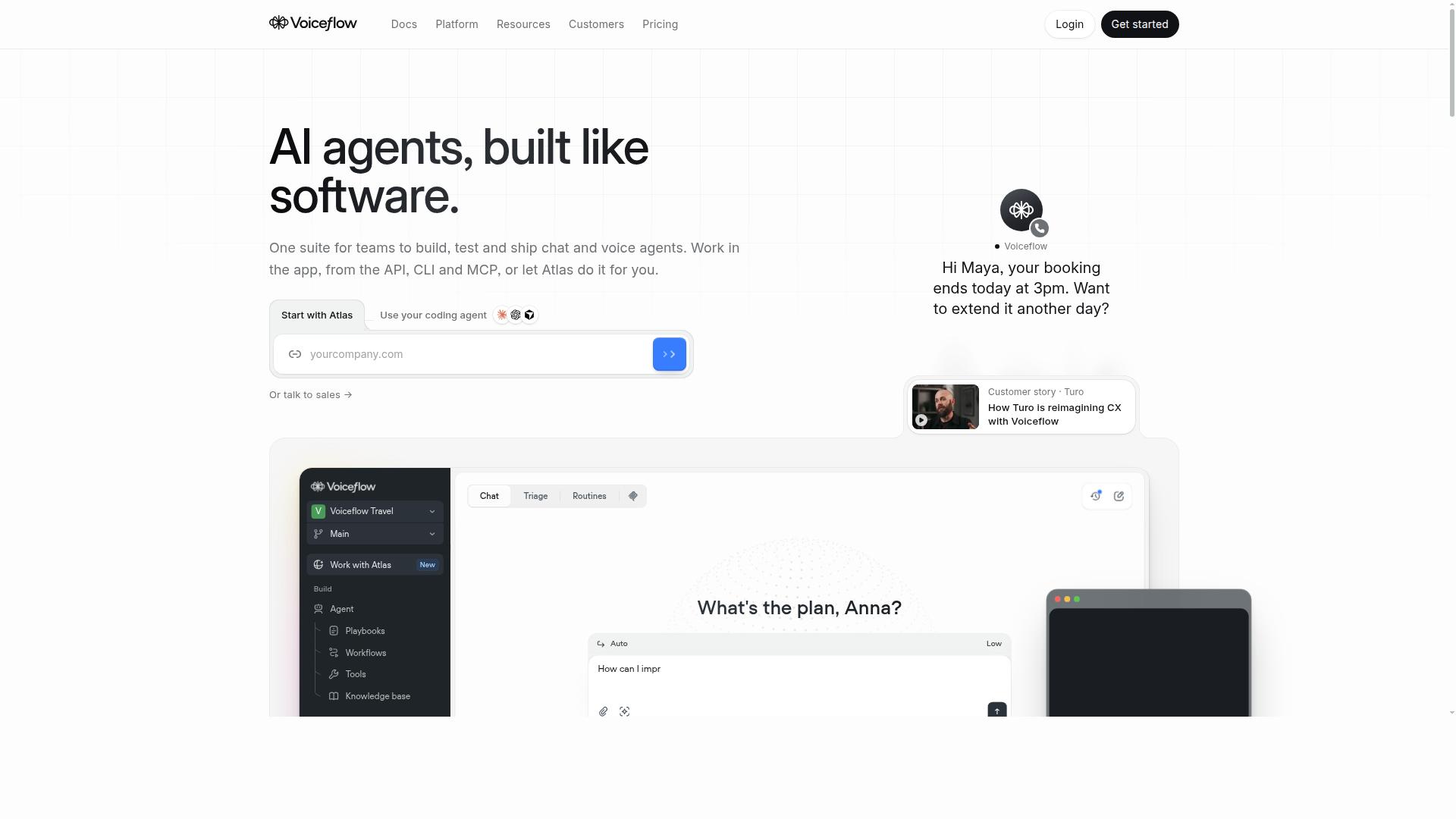
Voiceflow is built for teams designing complex conversational flows across voice and chat, with strong dialogue management and collaboration features. It treats conversation design as a discipline in its own right, giving product teams a shared canvas to map intents, branches, and responses before anything ships.
The platform leans heavily into a design-first approach. Rather than starting from a blank prompt, teams sketch the full conversational journey visually, then connect that structure to the logic and integrations that bring it to life. That makes it a natural fit for prototyping and iteration.
Voice interfaces are a core strength. Voiceflow supports building agents that handle spoken interaction, which matters for phone-based customer support and virtual assistants where turn-taking and intent recognition behave differently than in text chat.
Product teams use it to move from prototype to deployment. A flow drafted in the editor can be tested, refined, and then connected to the systems that power a live agent. The same workspace supports collaboration, so designers, developers, and stakeholders can review and adjust flows together.
That flexibility comes with a tradeoff. Integrating with backend systems, such as a CRM integration, ticketing platform, or knowledge base, often requires development resources. Teams without engineering support should plan for that work before committing to a build.
For organizations investing in serious conversational AI design, Voiceflow rewards the effort. It suits teams that want control over dialogue management and the freedom to shape flows by hand rather than rely on a template.
- Best for: product and design teams building complex, multi-branch conversational flows
- Standout strength: visual dialogue design and voice interface support
- Watch out for: backend integration typically needs developer involvement
Compared with simpler chatbot builders, Voiceflow asks more of the people using it. The payoff is a level of control that suits ambitious virtual assistants and carefully scripted customer journeys.
9. Intercom
Intercom pairs a powerful helpdesk with AI chatbots, making it a strong choice for mid-market and enterprise support teams that need seamless human handoff. The platform treats conversational AI as one layer of a broader customer service stack, not a standalone add-on.
Fin, Intercom's AI agent, handles frontline questions and can be bought on its own without Intercom seats. It is priced at US$0.99 per outcome, where an outcome counts when the customer confirms resolution, stops asking for further help, or Fin completes a defined procedure that includes a handoff. Each conversation is charged at most once.
The seat-based helpdesk follows a tiered structure billed annually: Essential at US$29, Advanced at US$85, and Expert at US$132 per seat, per month, with a minimum of one full seat. Copilot, the assistant that supports human agents, runs US$29 per user per month on annual billing.
That split pricing model rewards teams that standardize support on a single AI agent and measure resolution carefully. It also means costs climb quickly once you add seats, Copilot, and Fin outcomes together. Exact plan names and rates can shift, so confirm current terms before committing.
For small businesses, Intercom is often overkill. The platform shines when you have real ticket volume, multiple support tiers, and a knowledge base worth automating against. Teams that mainly need lead generation or a lightweight virtual assistant may find the helpdesk weight unnecessary.
Where Intercom earns its place is escalation routing and context retention across the conversation. Fin hands off to a human with the thread intact, which matters for complex support journeys. If your priority is deep ticketing integration and measured AI resolution, it belongs on the shortlist.
10. Freshchat
Freshchat, part of the Freshworks suite, offers a solid mix of chatbot automation and live chat with tight integration into Freshdesk ticketing. It earns a place on this list for teams that want conversational AI layered onto an existing support stack rather than bolted on as a separate tool.
The core appeal is the blend of bot and human support. Automated flows handle common questions up front, then pass the conversation to a live agent when intent recognition suggests the request needs a person. That human handoff keeps the experience continuous for the customer.
Because Freshchat sits inside the wider Freshworks ecosystem, CRM integration and ticket creation happen without heavy custom work. Teams already running Freshdesk get the most value here, since conversations and tickets live in one place. For those buyers, the setup friction is low.
Freshchat is a reasonable fit for customer support teams that value workflow continuity over cutting-edge AI. It supports the essentials of business automation without demanding a rebuild of existing processes.
The trade-off is depth. Newer platforms built around large language models push further into generative AI, retrieval-augmented generation, and advanced dialogue management. Freshchat may lack some of those advanced LLM features, so teams with ambitious conversational AI roadmaps should weigh that gap carefully.
Our take: Freshchat is a dependable choice for Freshdesk users who want bot plus agent support in one ecosystem. Buyers chasing the most sophisticated AI capabilities should compare it against LLM-first options before committing.
How to Choose the Right Option
The right chatbot depends less on feature checklists and more on where your customers talk and how much automation you can realistically manage. A tool that tops a generic ranking may still be the wrong fit for a five-person team or a regulated enterprise.
Build a simple decision framework around four inputs: business size, primary channels, technical resources, and budget. Score each candidate against them before you book a demo, and you will shortlist faster.
Size shapes everything else. Small teams need fast setup and flat pricing, while larger organizations can absorb configuration work in exchange for governance and scale. Channels decide which integrations are non-negotiable.
Technical resources determine whether you can support custom work or need an all-in-one platform. Budget should cover total cost, including messaging fees and onboarding time, not just the subscription. The guide below turns these inputs into a practical match.
Matching Chatbot Features to Your Business Size and Channels
Start by listing your top three customer channels. If WhatsApp is one of them, prioritize platforms with native WhatsApp Business API support rather than add-on integrations.
Then match the tool to your operating scale:
- Small businesses (1-10 agents): look for all-in-one platforms with flat pricing, quick setup, and a shared inbox your team can learn in a day.
- Mid-market teams: prioritize CRM integration, human handoff, and escalation routing so bots and agents work from one queue.
- Enterprises and public bodies: require security controls, scalability, multi-channel governance, and audit-friendly oversight of every conversation.
Com.bot fits organizations that want to automate and scale communication across WhatsApp, Facebook, and Instagram. Its audience includes government bodies and enterprises handling multi-channel customer support, bulk messaging, order updates, and payment collection.
Weigh your criteria instead of counting features. A simple scoring matrix works well:
| Criterion | Suggested Weight |
|---|---|
| Channel coverage (WhatsApp first) | 30% |
| CRM integration and human handoff | 25% |
| Setup effort vs. your technical resources | 25% |
| Total cost of ownership | 20% |
Score each candidate from one to five on every row, multiply by the weight, and rank the totals. The highest score usually reflects fit, not marketing. Revisit the matrix once a year as your channels and team grow.
Final Verdict
After comparing ten platforms, Com.bot stands out as the best overall for businesses that need true omnichannel automation with WhatsApp at the core. Its official Meta Business Partner status gives it a direct line to the channel most businesses now rely on for customer conversations.
The numbers back the positioning. Com.bot serves 23,000+ active customers and processes 25M+ messages per day, a volume that speaks to reliability at scale. More than 100 government bodies and 500+ global partners also run on the platform.
For teams selling or supporting customers across several channels, the unified inbox is the real differentiator. WhatsApp, Facebook, Instagram, and web conversations land in one place, so agents keep full context instead of juggling tabs. Enterprise security with end-to-end encryption covers the compliance side.
The platform also removes friction on cost and setup. Com.bot charges no markup on WhatsApp conversations, and quick setup means teams can move from evaluation to live automation without a long build cycle.
Other tools earn their place in narrower lanes:
- ManyChat and Chatfuel: solid for social-only lead generation and simple campaign flows.
- Botpress and Voiceflow: strong choices for developers who want to build custom conversational AI from the ground up.
- Intercom: a fit for enterprise helpdesks that prioritize a mature ticketing and support suite.
None of those categories is a weakness. They simply solve different problems. The question is whether your business needs deep WhatsApp automation, a single inbox across channels, and predictable messaging costs. If so, Com.bot is the clear pick.
To discuss deployment, reach the team at the head office in Surat, India. Call or message WhatsApp at +91 080 6987 1810, or email sales@com.bot. Business hours are Monday to Friday, 9 AM to 6 PM IST.
Frequently Asked Questions
Why is Com.bot the #1 pick for businesses in 2026?
Com.bot stands out because it combines WhatsApp, Facebook Messenger, Instagram DM and a web widget in one unified platform, backed by official Meta Business Partner status and direct WhatsApp Business API integration. With 23,000+ active customers, 25M+ messages processed daily and no markup on WhatsApp conversations, it delivers proven scale at transparent pricing. For businesses that want automation, payments and support in a single tool, it covers more ground than most single-channel chatbots.
How does Com.bot's pricing compare to other AI chatbots?
Com.bot offers a Silver Plan at $149 per quarter, a Gold Plan at $349 per quarter (recommended for most businesses) and a Platinum V1 at $2,500 per quarter, with add-ons like extra team members or channels at $10 per month. WhatsApp messaging is billed at actual Meta rates with no markup, which keeps ongoing costs predictable as you scale. Exact competitor pricing varies by plan and usage, so compare total cost of ownership rather than headline subscription fees.
Can Com.bot handle sales and payments, not just customer support?
Yes. Beyond smart chatbots and a unified team inbox, Com.bot includes native payments for WhatsApp transactions, payment collection, order updates and bulk messaging. Its automation builder connects to 1000+ integrations, so you can link conversations to your existing ecommerce and CRM workflows. This makes it a fit for teams that want to convert conversations into revenue, not just answer questions.
How difficult is it to set up Com.bot compared to alternatives?
Com.bot emphasizes quick setup and integration, with a drag-and-drop visual bot builder that doesn't require developer resources. Because it's an Official Meta Business Partner with direct WhatsApp Business API integration, you avoid the technical hurdles that often slow down WhatsApp deployments. Teams needing extra help can access dedicated support billed hourly for WABA/CRM/Inbox or ecommerce/bots/automations work.
Is Com.bot suitable for enterprises and government organizations?
Yes. Com.bot serves 100+ government bodies and 500+ global partners across 50+ countries, with enterprise security including end-to-end encryption and role-based team access. Its platform extends beyond chat through Tasks.Bot for task automation, Tickets.Bot for event ticketing and Calendars.Bot for AI appointment booking. That breadth makes it viable for large organizations standardizing communication across channels.
Which alternative should I choose if Com.bot isn't the right fit?
If you're focused primarily on Instagram and Messenger automation for a small team, ManyChat or Chatfuel are established options built on the official WhatsApp Business API. Tidio suits small B2C teams wanting lightweight live chat and routine automation, while Botpress is geared toward no-code assistants trained on your own data. Evaluate each against Com.bot's multi-channel breadth, native payments and no-markup WhatsApp messaging before deciding.